Fly-Tipping in the UK: Why It's a Growing Problem — and How to Avoid Getting Caught Up in It
What every homeowner in Liverpool and Merseyside should know before clearing out a house, garage, or garden.
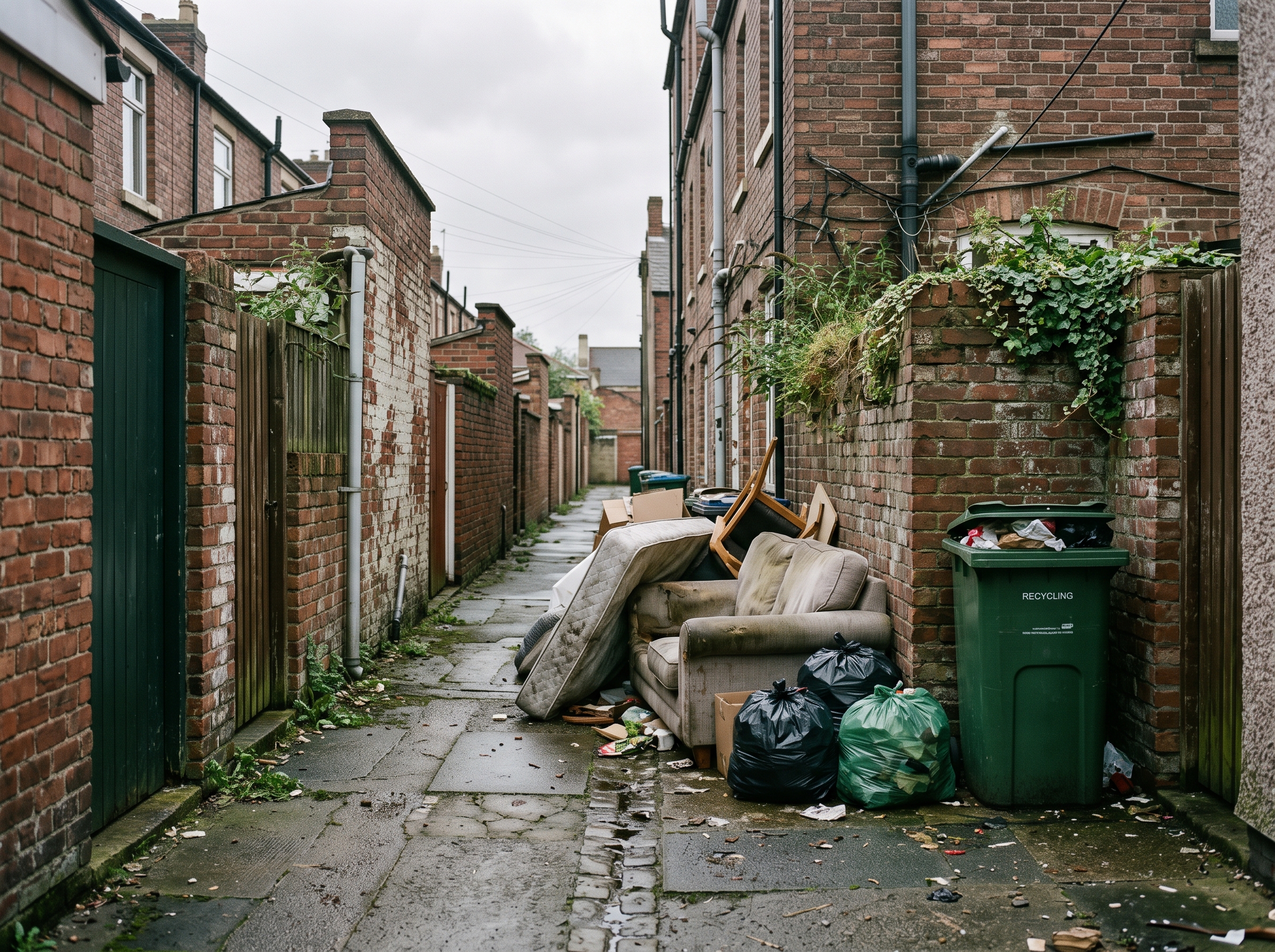
Every year, local councils across England deal with hundreds of thousands of fly-tipping incidents — illegally dumped mattresses in alleyways, builders' rubble on verges, bin bags piled beside industrial estates. It's one of the most visible forms of environmental crime in the UK, and it's a problem that touches ordinary homeowners far more often than they realise.
Here's the uncomfortable part: if you hire someone to clear your house, garage, or garden and they turn out to be unlicensed, you can be held responsible for where that waste ends up — even if you had no idea what they were planning to do with it.
This post breaks down what fly-tipping actually is, how big the problem is in the UK, what the penalties look like, how to report it if you spot it, and — most importantly — how to make sure you never end up connected to it, even accidentally.
How big is the problem, really?
Fly-tipping isn't a rare, fringe issue — it's one of the most commonly reported environmental crimes to local authorities in England. Councils record and investigate a large volume of incidents every single year, ranging from a single dumped sofa to significant illegal dumping grounds involving builders' waste, tyres, and household rubbish.
The cost isn't just visual. Clean-up falls on local councils (and ultimately taxpayers), it can contaminate soil and waterways, attract vermin, and create genuine safety hazards — especially when waste includes things like asbestos sheeting, broken glass, or chemicals.
What counts as fly-tipping?
It's a broader category than most people expect. Common examples include:
- Dumping furniture, mattresses, or appliances on the street or in alleyways
- Leaving builders' rubble, plasterboard, or renovation waste on verges or in fields
- Abandoning garden waste, soil, or hedge cuttings on public land
- Dropping bin bags of household rubbish outside your own property boundary, or someone else's
- A "man with a van" taking your unwanted items and dumping them rather than disposing of them properly
That last one is the scenario most relevant to house clearances — and it's more common than people assume, precisely because it's cheap and quick for the person doing the dumping. See how the fly-tipping trap catches homeowners out — and what the real financial cost looks like.
What are the penalties?
Fly-tipping is a criminal offence under the Environmental Protection Act 1990. The consequences can be serious, and they apply whether you're the one who dumped the waste or the one who handed it to somebody unlicensed to take away:
| Route | Possible consequence |
|---|---|
| Council fixed penalty notice | An on-the-spot fine, issued without needing to go to court |
| Magistrates' Court conviction | A significant fine, and a criminal record |
| Crown Court conviction (serious/repeat cases) | Unlimited fine and/or a prison sentence |
| Failing your "Duty of Care" | A separate offence — even if you never touched the waste yourself |
Your "Duty of Care" as a homeowner
This is the part most people genuinely don't know about. Under UK law, anyone who produces waste — including you, clearing out your own house — has a legal Duty of Care to make sure it's handed over to someone authorised to take it.
In practice, that means:
- Checking that whoever collects your waste holds a valid Upper Tier Waste Carrier Licence from the Environment Agency
- Asking where the waste is actually going — a legitimate operator should be able to tell you
- Keeping some form of record (a receipt, a licence number, a booking confirmation) in case it's ever questioned
If you skip this step and hire the cheapest "man with a van" you can find on a classifieds site, and that person dumps your three-piece suite in a lay-by outside Widnes, you can be investigated and fined too — because the law asks you to take reasonable steps to avoid exactly this outcome.
How to check if a company is licensed
This takes about two minutes and it's the single best protection you have:
- Ask the company for their Waste Carrier Licence number
- Go to the Environment Agency's public register
- Search the licence number and confirm it's valid, current, and matches the company name
If a company is reluctant to share their licence number, or the details don't match — that's your answer. Walk away, no matter how good the quote is.
How to report fly-tipping if you spot it
If you come across dumped waste — whether it's in your street or somewhere you're walking — here's what helps:
- Note the location as precisely as possible (postcode, nearest landmark)
- Take photos if it's safe to do so, without touching or disturbing the waste
- Note the date and time, and any vehicle details if you saw one involved
- Report it to your local council — most have an online fly-tipping report form, and England-wide reports can also go through gov.uk/report-flytipping
FAQ
Can I get in trouble even if I didn't dump the waste myself?
Yes. If you handed your waste to someone unlicensed and it was then fly-tipped, you can still be investigated for failing your Duty of Care.
Does this apply to garden waste too, not just furniture?
Yes — soil, hedge cuttings, and green waste dumped illegally still count as fly-tipping, and the same Duty of Care rules apply to who removes it.
What if the company shows me a licence number but I can't check it on the spot?
Don't proceed on trust alone. Legitimate companies won't mind you taking a moment to verify it on the Environment Agency register before confirming the job.
Is it more expensive to use a licensed clearance company?
Not necessarily — many licensed local operators are competitively priced. The real cost of going unlicensed isn't usually money saved, it's the risk you're taking on.
Skip the risk — get quotes from licensed clearance companies
JunkBid only works with clearance companies who hold a valid Upper Tier Waste Carrier Licence, so you're covered from the start.
GET YOUR FREE QUOTE →