House Clearance Scams in Liverpool: How to Spot and Avoid Them
You've decided to book a house clearance. You search online, find someone who sounds reasonable, agree a price — and then things go wrong. The rubbish ends up dumped on a country lane. You get a bill for three times the original quote. Or the company simply disappears after taking your money.
These aren't rare horror stories. Clearance scams are a genuine problem across Merseyside — and Liverpool, with its high density of rental properties and estates, is a prime target. This guide explains exactly what to watch out for and how to protect yourself.
Why House Clearance Scams Happen
House clearance sits in an awkward gap. It's an unregulated industry at the point of sale — anyone can advertise clearance services on Facebook Marketplace or Gumtree without any visible credentials. The only legal requirement is an Upper Tier Waste Carrier Licence from the Environment Agency, but customers rarely think to ask for it.
That gap attracts two types of bad actor: opportunistic individuals who dump waste illegally to avoid tip fees, and organised rogue traders who deliberately underquote, then pressure customers for more money once the job has started.
The Most Common House Clearance Scams in Liverpool
1. The Vanishing Quoter
Someone provides a very low quote — sometimes over the phone without even seeing the property — takes a cash deposit, and never returns. This is especially common around large estates and bereavement clearances, where families are under pressure and want the job dealt with quickly.
Red flag: No company name, no written quote, and insistence on cash upfront before any work begins.
2. The Mid-Job Price Escalation
The job starts at £150. Once the van is half-loaded and your furniture is in the street, the operator announces the price is now £400 because there's "more than expected." At that point, many people pay — because the alternative is reassembling everything themselves.
Red flag: No written confirmation of the scope and price before work begins. Operators who are vague about what's included.
3. The Fly-Tipping Disposal Route
Your items are collected and loaded — but instead of going to a licensed recycling facility or tip, they're dumped in a lay-by, industrial estate, or on open land in Merseyside. You're left with a legal liability you didn't know you were taking on.
Red flag: The operator cannot provide a Waste Transfer Note after the job. Quotes are suspiciously far below market rate (if someone is quoting £80 for a full van load, they are almost certainly not paying tip fees).
4. Fake Reviews and Borrowed Legitimacy
Some operators copy the branding, trading name, or licence numbers of legitimate businesses, or build up Google reviews rapidly using fake accounts. A company that looks established online may have been registered last month.
Red flag: A large volume of reviews all posted within a short window, all with generic phrasing. No verifiable physical address.
5. The "Man With a Van" Who Isn't Licensed
This is the most common situation and often not intentionally fraudulent — it's simply someone offering clearance as a side income without realising (or caring) that they need a Waste Carrier Licence to legally transport other people's waste. The result is the same: your waste may be disposed of illegally, and you bear the duty-of-care risk.
We've written about this specific issue in more detail: That Cheap "Man With a Van" Could Cost You Thousands — The Fly-Tipping Trap Explained.
How to Verify a Clearance Company Before Booking
The good news: most of these scams are avoidable with a few simple checks. Here's what to do before handing over any money.
Step 1 — Check the Waste Carrier Licence
Every legitimate clearance company must hold an Upper Tier Waste Carrier Licence from the Environment Agency. You can verify any licence number in seconds at environment.data.gov.uk. Ask the company for their licence number before booking. A legitimate operator will provide it without hesitation.
Step 2 — Get Everything in Writing
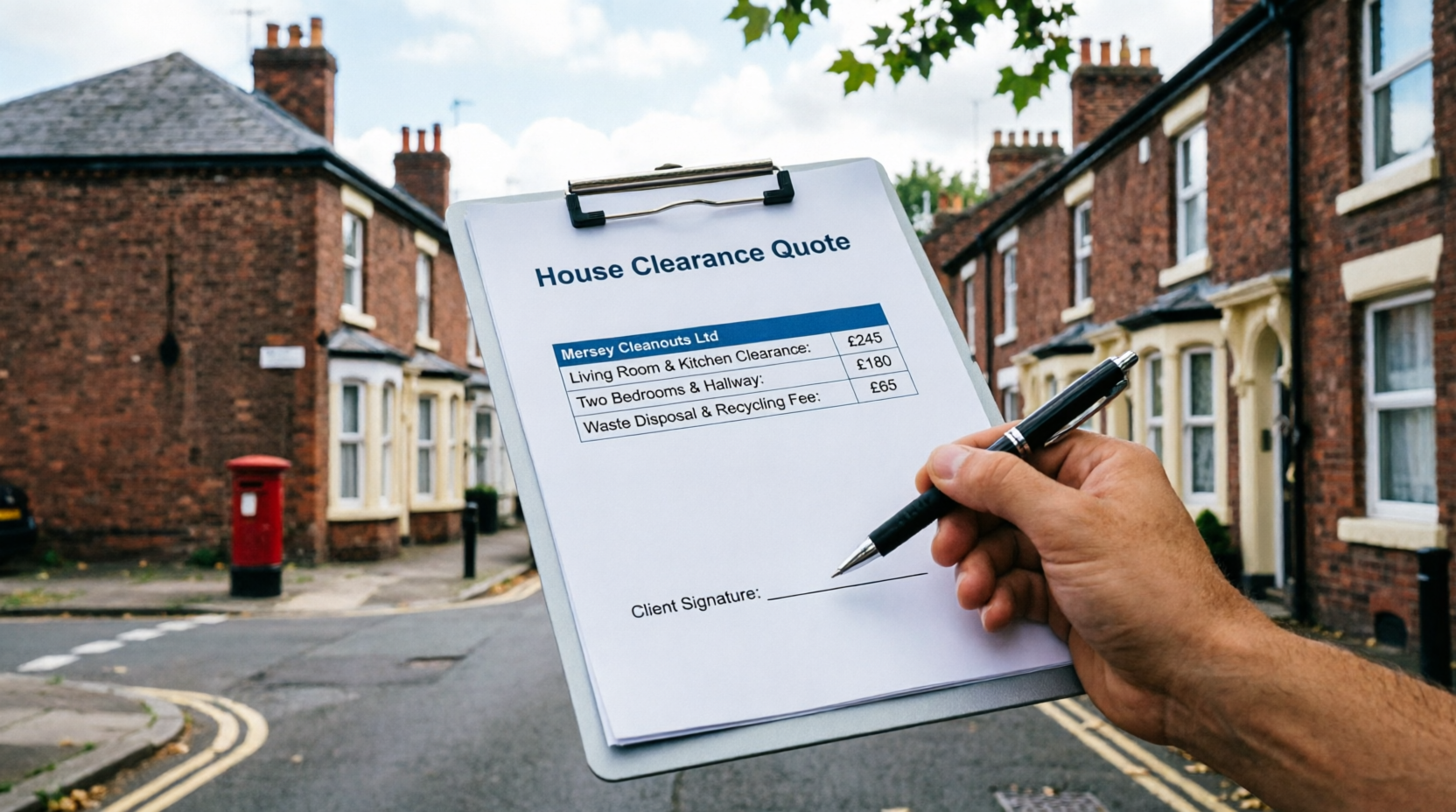
Before any work starts, you should have written confirmation of: the total price, what's included, what's not included, and how the waste will be disposed of. If a company resists putting anything in writing, treat that as a serious warning sign.
Step 3 — Avoid Large Cash Deposits
A small deposit (10–20%) to secure a booking is normal and reasonable. Anything larger — or any insistence on full cash payment upfront — is a red flag. Paying by card or bank transfer gives you more recourse if something goes wrong.
Step 4 — Check Their Digital Footprint
Search the company name plus "Liverpool" or "Merseyside." Look for a consistent trading history — a website, Google Business listing, and reviews spread over time. Be cautious of companies that only exist on Facebook Marketplace or have no reviews older than a few months.
Step 5 — Request a Waste Transfer Note
After the job, a licensed operator is legally required to provide a Waste Transfer Note — a document confirming your waste has been handed to a licensed carrier. If they can't or won't provide one, your duty of care has not been properly fulfilled.
How JunkBid Protects You From These Risks
JunkBid was built specifically to remove the verification burden from the customer. Every provider on the platform holds a verified Upper Tier Waste Carrier Licence — checked against the Environment Agency register before they're approved. You get competing quotes from licensed companies, with a fixed 10% deposit model and no ambiguity about pricing.
We also operate as a marketplace, which means you're comparing multiple legitimate providers rather than taking a chance on a single operator found through an ad. That competitive structure keeps pricing honest and makes mid-job price escalations impossible — the price you see is the price you pay.
For context on how the council's own collection service compares, see our guide: Council Bulky Waste Collection vs Private Clearance in Liverpool: Which Should You Choose?
Get quotes from licensed, verified clearance companies across Liverpool & Merseyside — no upfront cost, no risk.
Get Your Free Quotes →What to Do If You've Already Been Scammed
If you've paid a clearance company that has now disappeared, or you suspect your waste has been fly-tipped:
- Report fly-tipping to your local council (Liverpool City Council, Wirral Council, Warrington Borough Council — each has an online reporting form).
- Report the company to the Environment Agency if they were operating without a licence: call 0800 80 70 60 or use their online report form.
- If you paid by card, contact your bank immediately — you may be able to initiate a chargeback.
- Report to Trading Standards via Citizens Advice (0808 223 1133) if you believe you've been deliberately defrauded.
Frequently Asked Questions
How do I check if a clearance company is licensed in Liverpool?
Search for their company name or licence number on the Environment Agency's public register at environment.data.gov.uk. It's free, takes under a minute, and will confirm whether their Upper Tier Waste Carrier Licence is current and valid.
Can I be fined if a company I hire fly-tips my rubbish?
Yes. Under the Environmental Protection Act 1990, you have a duty of care as the waste producer. If you fail to use a licensed carrier and your waste is illegally dumped, you can face a fixed-penalty notice or, in serious cases, prosecution. The fine can be substantial. This is why licence verification matters before you book, not after.
What's a fair deposit for a house clearance in Liverpool?
A deposit of 10–20% of the total quote is standard and reasonable. It secures your booking slot and covers the company's preliminary costs. Anything beyond 50% upfront — especially in cash — is a warning sign and not industry standard practice.
What should a legitimate clearance quote include?
A proper written quote should confirm the total price, the items or volume covered, how the waste will be disposed of (ideally specifying recycling or licensed facility), the company's name and licence number, and any exclusions. If a quote is verbal only and vague about scope, ask for it in writing before proceeding.
Is it illegal to hire an unlicensed clearance company?
Yes — for both parties. Under Section 34 of the Environmental Protection Act 1990, handing your waste to an unauthorised person is a direct breach of your Household Waste Duty of Care, which is a criminal offence. It's not just a risk you're taking — it's unlawful. You as the waste producer, and the unlicensed carrier, can both face a Fixed Penalty Notice or, in serious cases, prosecution and an unlimited fine. Checking the licence before booking is not optional — it's a legal obligation.