
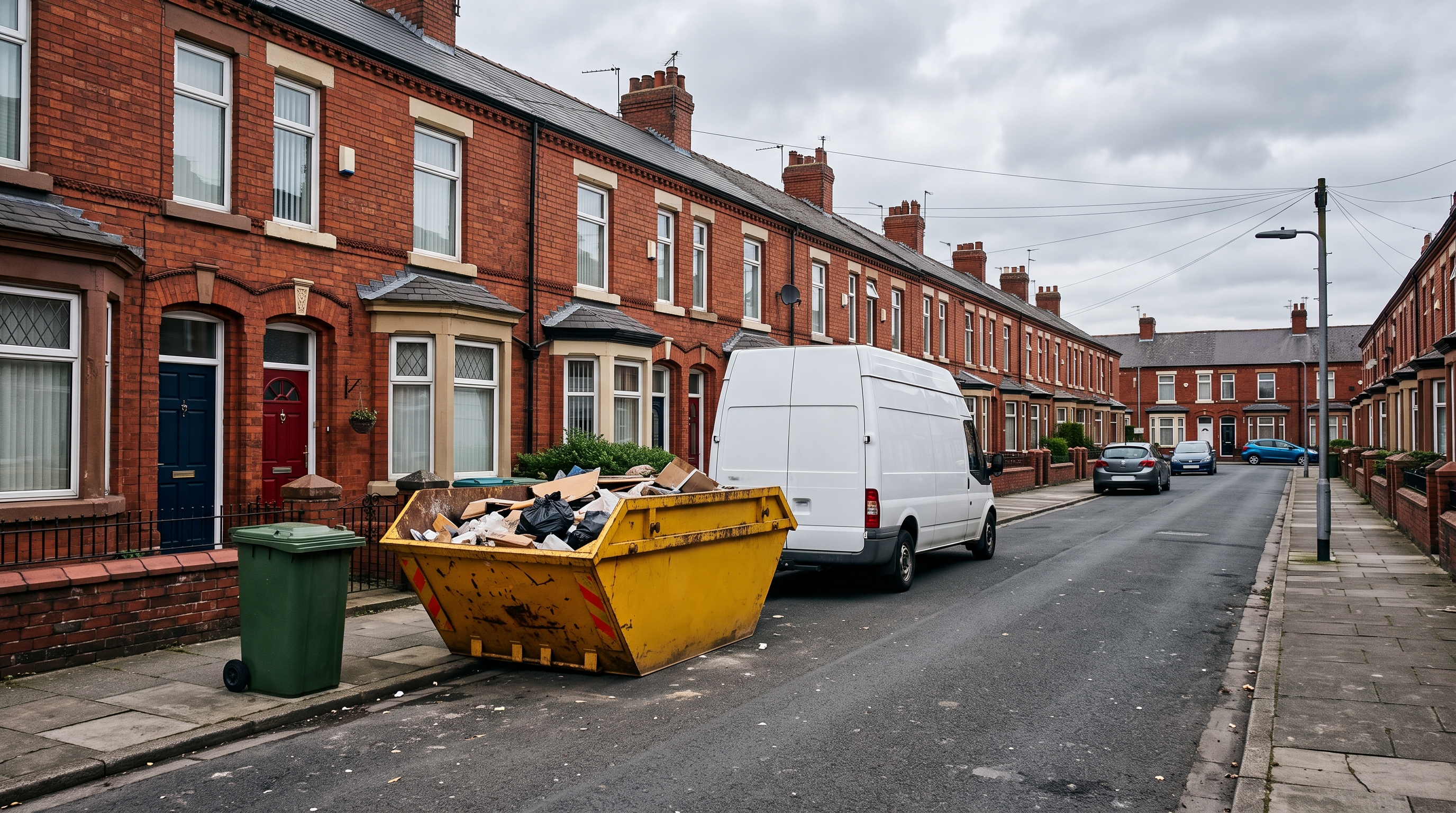
Skip Hire vs House Clearance in Liverpool: 2026 Costs, Permits and Which to Book
A skip on a Liverpool street needs a £44 council permit that lasts 7 days, and fridges cannot go in it at all. A licensed clearance crew needs no permit and loads everything in one visit, but costs more for rubble and soil. Below: real 2026 prices, a worked cost comparison for a terraced house, and a clear rule for which one to book.
The short answer: which one to book
Neither option wins every time. The deciding question is what you are throwing away, not how much of it there is.
- Book a skip for heavy, uniform waste you load yourself over several days: rubble, soil, concrete, old tiles from a DIY renovation, ideally with a driveway so no permit is needed.
- Book a clearance crew for furniture, white goods, mattresses, sofas and mixed household contents, especially in a terraced street with no off-road parking, or when you need the property empty in one day.
- Use the free council collection if you only have up to five bulky items and can put them outside yourself.
Clearing a parent's home, an end of tenancy, or a garage full of furniture? The rest of this guide shows why the clearance crew usually comes out cheaper once you add permits, surcharges and your own time.
What skip hire involves in Liverpool
A skip company drops a steel container at your property. You fill it at your own pace and call for collection. On paper, the model is cheap and flexible. On a Liverpool street, five practical issues decide whether it works for you.
1. The £44 permit and the 7-day clock
A skip on a public road needs a licence from Liverpool City Council. Only registered skip operators can apply, so the skip company arranges it for you. The council charges £44 per skip, and each permit runs for a maximum of 7 days. If the skip stays longer, the operator must apply for a new permit. No permit is needed on a driveway or an unadopted road.
Two further council rules catch people out. The skip must sit wholly on the roadway, with no part on the pavement. And in city-centre locations, skips must be removed the same day unless they are enclosed lockable skips.
2. Neighbours filling your skip
An open skip on a terraced street invites passers-by to add their own rubbish overnight. You pay for the extra weight, and anything banned that ends up inside, such as a dumped fridge, becomes your problem at collection.
3. You do all the loading
Every item has to be carried out and lifted in by you or your helpers: wardrobes down narrow terrace stairs, a three-piece suite through a front door that opens straight onto the street.
4. Banned and surcharged items
Fridges and freezers, TVs and other electricals (WEEE), tyres, gas bottles, asbestos and hazardous chemicals cannot go in a general waste skip. Mattresses and upholstered seating are banned or surcharged by many operators. Each of these needs a separate disposal route on top of the skip cost.
5. Guessing the size
Book too small and you pay for a second skip and, on a road, a second £44 permit. Book too large and you pay for empty capacity.
Sofas, armchairs and the POPs rules
Older sofas, armchairs and other upholstered seating can contain persistent organic pollutants (POPs), flame-retardant chemicals that must not go to landfill. Under Environment Agency guidance on upholstered domestic seating, enforced since 2023, this waste has to be kept separate and destroyed at a suitable facility rather than mixed with general waste.
The practical effect for you: many skip companies now refuse upholstered seating outright, or add a surcharge, typically £40–£80 per item. Liverpool City Council's own bulky collection asks residents to wrap any damaged or torn upholstered item in plastic sheeting or tape it before collection, for the same reason.
Practical tip: If your clear-out includes even one sofa or armchair, ask every skip company in writing whether they accept it and at what price before you book. Licensed clearance companies routinely collect upholstered seating; confirm it is included when you request quotes.
What a licensed house clearance involves
A clearance company sends a crew and a van, loads everything you have agreed, and takes it away, usually in a single visit. You do not lift anything, and no permit is needed because the van parks, loads and leaves.
The crew must hold an Upper Tier Waste Carrier Licence from the Environment Agency, because they carry other people's waste. Every provider on JunkBid has its licence number checked against the Environment Agency public register before it can quote.
Two points to agree before the crew arrives:
- Fixed price or per-load? Some companies add charges on the day for heavy items, upper floors without a lift, or specialist disposal. Send clear photos and a full item list in advance, and ask for the quote in writing with any extras listed.
- What they will not take. Asbestos, gas cylinders and hazardous chemicals need specialist contractors. Builder's rubble and soil are often excluded or charged by weight.
2026 costs: skip vs clearance vs council collection
| Option | Typical cost | What you get | Extra costs to budget for |
|---|---|---|---|
| 6-yard skip | £180–£350 | Container for 7–14 days; you load it | £44 road permit per 7 days; sofa surcharges; separate disposal for fridges and electricals |
| 8-yard skip | £240–£290 | Most common size for a full room or garage | As above; a second skip if you overfill |
| Larger skips (10–12 yard) | £300–£500+ | Renovation-scale volume | Heavy waste such as soil may be restricted to smaller skips by weight |
| Clearance: single room or garage | £150–£350 | Crew loads and removes everything agreed, one visit | Agree extras in writing (stairs, heavy items, specialist disposal) |
| Clearance: full house | £400–£900 | Whole property cleared, WEEE and upholstery separated | Fitted kitchens, asbestos and deep cleaning are quoted separately |
| Liverpool council bulky collection | Free | Up to 5 bulky items, plus up to 5 small electricals and 5 bags of textiles | Your time: you must put every item outside yourself |
Budgeting note: VAT and probate costs
Liverpool only lets registered skip operators apply for road permits, so the £44 fee reaches you through the skip company's invoice. A VAT-registered operator may add VAT when it recharges the permit, which turns £44 into £52.80. Ask whether quotes include the permit and VAT.
Clearing the home of someone who has died? The property may qualify for the Class F Council Tax exemption from the date of death until probate is granted, plus up to six months afterwards. It is not automatic; you must apply to the council. See our guide to clearing an inherited property in Liverpool.
The free council service is generous for small jobs: it collects sofas, armchairs, mattresses, fridges, freezers and washing machines. But it is not a clearance service. Liverpool City Council excludes house clearances, will not collect from landlord or To Let properties, and collects from outside your home only, between 7.30am and 4.30pm on your collection day. Book on liverpool.gov.uk.
Worked example: clearing a 3-bed terrace in Walton
Three-bedroom terrace, Walton, L4. Street parking only.
Contents: two sofas, one fridge-freezer, two wardrobes, beds, a dining set, and bags of general household items. Roughly one full van load.
Route A: skip
- 8-yard skip: £240–£290
- Council road permit: £44 (7 days)
- Two sofas surcharged at £40–£80 each: £80–£160
- Fridge-freezer: cannot go in the skip; take it to Otterspool or Old Swan recycling centre, or wait for a council bulky collection
- Labour: you and your helpers, a full weekend
Total: £364–£494, plus your time, a separate fridge run, and the risk of needing a second skip and permit (another £284–£334).
Route B: licensed clearance crew
- Full van load including both sofas and the fridge-freezer, two-person crew, one visit of around 3–5 hours
- No permit, no separate fridge disposal, no loading
Total: £400–£650 from licensed Merseyside carriers.
The gap between the two routes is £36–£156 in the skip's favour at best, and the skip becomes the more expensive option the moment a second skip is needed. For mixed household contents, the clearance crew is usually the better deal.
Head-to-head: 8 factors that decide it
| Factor | Skip hire | House clearance |
|---|---|---|
| Physical effort | You load everything yourself | Crew does all the lifting |
| Price certainty | Fixed rate per skip size | Quotes differ; compare 3–5 licensed companies |
| Council permit | £44 per 7 days if on the road | Not needed |
| Sofas, fridges, mattresses | Banned or surcharged by many operators | Routinely collected and separated |
| Speed | Days to fill, plus collection scheduling | Usually one visit |
| Rubble, soil, concrete | Built for heavy uniform waste | Often excluded or charged by weight |
| Pace of work | Fill gradually within the hire period | Fixed date; you need to be ready |
| Licence check | Your job: verify the operator on the EA register | Pre-checked for every JunkBid provider |
Which one is right for your job
Book a clearance crew if…
- You are clearing furniture, appliances or mixed household items
- There is a sofa, armchair, mattress or fridge in the load
- You cannot, or do not want to, do the lifting
- You need the property empty in one day
- You live in a terrace with no driveway
- It is a bereavement, probate or end-of-tenancy clearance
Book a skip if…
- The waste is rubble, soil, concrete or tiles
- You have a driveway, so no permit is needed
- You want to load gradually over a renovation
- A fixed upfront price matters more than labour
- There are no sofas, fridges or electricals in the load
Third option: the free council collection. Right for one sofa, a mattress or a fridge from an owner-occupied home in Liverpool, up to five bulky items per collection. Wrong if you are on an upper floor and cannot carry items outside, if the property is a landlord or To Let property, or if you are clearing a whole house: the council excludes all three.
Your legal duty of care and the fines
Whichever route you choose, the law treats your waste as your responsibility until it reaches a legitimate disposal site. Under Section 34 of the Environmental Protection Act 1990, householders have a duty of care to pass waste only to an authorised person, such as a registered waste carrier.
What breaking the duty of care costs
- Up to £600: fixed penalty notice for a householder who hands waste to someone without checking they are authorised.
- Up to £1,000: on-the-spot fixed penalty for small-scale fly-tipping.
- Unlimited fine: on conviction in court for fly-tipping.
Councils trace fly-tipped loads using documents, addresses and items found in the waste. A cheap cash-in-hand van that dumps your sofa in an alleyway can lead the council back to your door.
Fly-tipping is not a marginal problem: Defra's fly-tipping statistics for England record over one million incidents a year. The check that protects you takes about a minute: search the carrier's name or licence number on the Environment Agency public register at environment.data.gov.uk and confirm it shows as an Upper Tier carrier.
Skip companies are also regulated: Liverpool City Council only registers skip operators who prove a current waste carrier's licence and at least £5 million public liability insurance. The highest risk sits with unregistered "man with a van" operators who advertise on social media and take cash.
Red flags: skip and clearance operators to avoid
- Cannot give you an Environment Agency waste carrier licence number, or the number does not appear on the public register
- Quotes far below every other company with no explanation of where the waste goes
- Cash only, no written quote, no receipt
- Cannot name the facility where your waste will be tipped
- Will not provide a waste transfer note or receipt showing their licence number
- Skip company says "no permit needed" for a skip on a public road; the £200 council fine plus the £44 fee lands on the job
- Happily takes your fridge, mattress and sofas at no extra cost into an ordinary skip
Spot any one of these and walk away. The fine for a fly-tipped load is far higher than any saving on the quote.
Step by step: from first quote to cleared property
- Sort the load into three groups. Heavy waste (rubble, soil, tiles), household contents (furniture, bags, boxes), and restricted items (fridges, electricals, sofas, mattresses, gas bottles). The mix decides the route.
- Check where a skip would stand. On a driveway or unadopted road, no permit is needed. On a public road, budget £44 per skip per 7 days, and confirm the skip will sit wholly on the road, not the pavement.
- Request written quotes for both routes. Ask skip companies whether the price includes the permit and VAT, and their charge per sofa. Post the job on JunkBid with photos and an item list to get clearance quotes from licensed local carriers.
- Verify the licence before you book. Search the company's name or licence number at environment.data.gov.uk and confirm it is an Upper Tier registration that has not expired.
- Book the free council collection for any leftovers. If a few bulky items fall outside the skip or clearance quote, book Liverpool City Council's free bulky collection for up to five items.
- Get a waste transfer note or receipt on the day. It should show the company name, licence number, a description of the waste and where it is going. Keep it for at least two years.
Frequently asked questions
Do I need a permit if the skip goes on my own driveway?
No. Liverpool City Council only requires a skip permit when the skip is placed on a public road. Skips on driveways or unadopted roads do not need one.
How much is a skip permit in Liverpool and how long does it last?
The council charges £44 per skip, and each permit lasts a maximum of 7 days. Only registered skip operators can apply, so your skip company arranges it. A skip found on the road without a permit triggers a £200 fine plus the £44 fee.
How much does a house clearance cost in Liverpool?
A single room or garage typically costs £150–£350. A full house clearance typically costs £400–£900, depending on volume, access and specialist items. Compare written quotes from several licensed companies for your specific job.
Can I put a sofa or a fridge in a skip?
Fridges and freezers cannot go in a general waste skip because they contain controlled refrigerant gases and count as electrical waste. Many skip companies also refuse upholstered sofas and armchairs, or surcharge them at around £40–£80 each, because of the POPs rules. Licensed clearance companies routinely collect both.
What licence should a skip or clearance company hold?
Any company carrying other people's waste needs an Upper Tier Waste Carrier Licence from the Environment Agency. Check the name or licence number on the public register at environment.data.gov.uk before you book. Every JunkBid provider is checked against the register before it can quote.
Is the council bulky item collection free in Liverpool?
Yes. Liverpool City Council collects up to five bulky items free, plus up to five small electricals and five bags of textiles. Items must be outside your home on collection day, between 7.30am and 4.30pm. The service excludes house clearances and landlord or To Let properties.
How do I get house clearance quotes in Liverpool?
Post your job on JunkBid with photos and a description of what needs clearing. Licensed local carriers send competing quotes, and you choose. There is no obligation and no upfront cost.
Related guides
Clearing a Liverpool property this month?
Post the job once and licensed local carriers send you competing quotes. Or check any carrier's licence before you hand over a single bag.