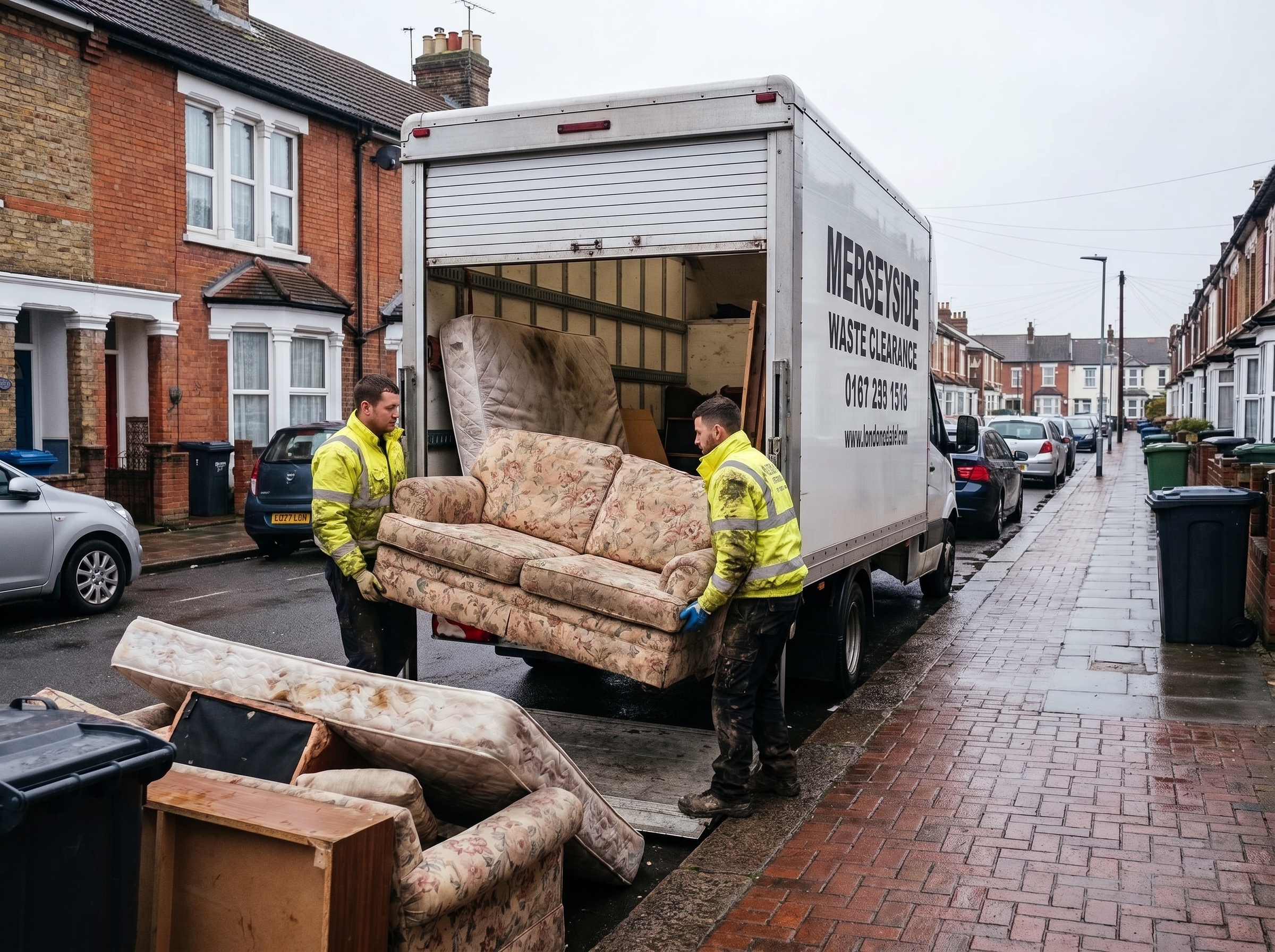
The Comprehensive Guide to Bulky Waste Disposal in Liverpool & Greater Merseyside
Managing large-scale waste removal within the Liverpool City Region is an operational challenge that impacts property managers, residential homeowners, and independent contractors alike. Whether you are executing an end-of-tenancy clearance in Toxteth, stripping out a retail unit in St Helens, or managing domestic upgrades in the Wirral, understanding the regulatory and logistical framework of waste management is essential.
In the United Kingdom, waste management is heavily regulated under environmental protection laws. Illegal disposal, commonly known as fly-tipping, is treated as a serious criminal offense. Fines are unlimited, and non-compliance can ruin a local business's reputation. This comprehensive guide provides an analytical breakdown of public, self-service, and private on-demand solutions across Merseyside, enabling you to optimize for speed, cost, and legal compliance.
1. The Public Infrastructure: Council Bulky Waste Collections
Local authorities across the five Merseyside boroughs offer domestic bulky waste collection services. While these services represent the lowest direct financial cost, they operate under strict structural limitations, item quotas, and lengthy lead times that introduce severe operational friction.
Liverpool City Council
- Allocation Matrix: Residents can book up to 5 bulky items per request. Up to 5 electrical items can be counted separately within specific categories.
- Logistical Bottleneck: Demand across the city is high. Waiting lists frequently extend from 7 to 21 working days.
- Presentation Rules: All items must be placed outside the property boundary by 6:45 AM on the designated day. Council staff are legally prohibited from entering private property, meaning the householder must absorb the physical labour and liability of moving heavy items to the kerbside.
- Strict Exclusions: Demolition waste, heavy timber, hazardous chemicals, and large sheets of glass or mirrors will be rejected at the roadside.
Sefton Metropolitan Borough Council
Serving Bootle, Crosby, Southport, and Formby, Sefton Council operates a tiered charging model for specific items, moving away from free blanket collections. White goods and heavy furnishings require separate, dedicated bookings. Waiting times scale up significantly during peak seasons (spring and summer quarters).
Wirral Council
Wirral utilizes a contracted partner system for collections. The core constraint here is the definition of a "single item." For example, a bed frame and a mattress are categorized as two separate items, quickly exhausting the standard quota. Booking modifications are restricted once submitted, introducing rigidity for dynamic clear-outs.
Knowsley & St Helens Councils
Both boroughs enforce rigorous verification processes to ensure services are not exploited by commercial entities. Any suspicion that waste originates from property development, professional landlord activities, or trade works results in immediate cancellation of the booking without notice.
2. Regulatory Pivot Point: The POPs Legislation Crisis
A critical factor driving rejection rates in council collections is the Environment Agency’s strict enforcement of regulations regarding POPs (Persistent Organic Pollutants). This applies directly to domestic upholstered seating, including:
- Sofas, armchairs, and upholstered stools.
- Home office chairs and dining chairs with fabric elements.
- Futons, cushions, and beanbags.
Because these items contain hazardous flame retardants, they cannot be mixed with standard municipal waste. They must be collected via specialized transport streams and incinerated under strictly controlled conditions. If an item is torn or damaged, exposing the inner foam, many standard municipal collectors will refuse pick-up due to contamination risks, forcing the owner to seek specialist private remediation.
3. The Self-Service Route: Household Waste Recycling Centres (HWRCs)
For individuals with immediate access to transport and physical capacity, the Merseyside Recycling and Waste Authority (MRWA), in partnership with Veolia, operates a network of 16 strategic regional recycling hubs.
Strategic Merseyside Hub Locations:
- Liverpool: Otterspool (South) and Gillmoss (North - highly optimized for high-volume intake).
- Knowsley: Huyton and Kirkby sites.
- Sefton: South Sefton (Bootle) and Formby.
- Wirral: Bidston, Clatterbridge, and West Kirby.
- St Helens: Ravenhead and Rainfont locations.
The Operational Friction of HWRCs:
While access is generally free for standard domestic cars, the system introduces significant operational friction if you utilize commercial-type vehicles to move bulky items efficiently:
- The Van Permit Scheme: If you utilize a transit van, pick-up truck, or a trailer over 3 meters in length, you are legally blocked from entry unless you possess a pre-booked digital vehicle permit.
- Permit Quotas: Domestic users are limited to a fixed number of van permits per year, and bookings must be made days in advance, stripping away the agility required for sudden property clearances.
- The Commercial Fraud Trap: If site operatives suspect the waste is commercial (e.g., trade off-cuts, commercial packaging, landlord clearance items), the vehicle is blacklisted immediately. Commercial waste disposal at these sites is illegal and subject to prosecution.
4. Public vs. Private Waste Solutions: A Comparative Matrix
To optimize decision-making, businesses and property owners must evaluate the trade-offs between public infrastructure and professional on-demand private waste services.
| Operational Metric | Council Collection Services | Private On-Demand Services |
|---|---|---|
| Lead Time / Speed | 7 to 21 business days. Highly rigid scheduling. | Same-day or next-day service window availability. |
| Volume & Capacity | Strict limits (typically 3–5 items per booking). | Scalable. From single item to multi-van load capacities. |
| Labour Allocation | Zero. Kerbside placement required by applicant. | Full service. Internal removal, lifting, and sweeping included. |
| Acceptance Breadth | Excludes construction, demolition, and damaged POPs. | Broad acceptance, including trade waste and light rubble. |
| Regulatory Risk | Low (if items meet strict criteria). | Zero (if verified via Licensed Waste Carriers). |
5. Mitigating Legal Liability: The Legal "Duty of Care"
Under Section 34 of the Environmental Protection Act 1990, individuals and corporate entities hold an absolute, non-delegable Duty of Care for all waste generated on their premises. This means your legal liability does not terminate when waste leaves your property boundary.
"If you hire an unverified operator—such as a cheap 'man with a van' sourced from social media marketplaces—and that operator subsequently fly-tips your waste on a Merseyside bypass or in an alleyway, you remain criminally liable."
Local enforcement officers across Liverpool, Sefton, and Wirral actively audit fly-tipped sites for identifying documentation (invoices, utility bills, addressed packaging). Homeowners and business operators caught using unlicensed carriers face an immediate Fixed Penalty Notice (FPN) of £400, which can escalate to unlimited judicial fines and a permanent criminal record.
Protocol for Complete Risk Mitigation:
- Validate the License: Request the operator's 9-digit Environment Agency Waste Carrier License number. Cross-reference it instantly via the official UK government online register.
- Demand a Waste Transfer Note (WTN): A professional service will always provide a compliant WTN detailing the exact volume, classification of waste, vehicle registration, and the designated, licensed processing facility where the waste will be dropped.
- Retain Documentation: Under UK law, commercial entities must retain all Waste Transfer Notes for a minimum of two years for environmental agency inspection purposes.
6. The Strategic Business Solution: On-Demand Platforms
For modern enterprises, independent tradesmen, and busy landlords, the manual coordination of waste disposal represents an unnecessary burn of billable hours. The strategic solution lies in leveraging professional, tech-driven on-demand waste clearance platforms.
By bypassing the administrative friction of council booking portals and avoiding the logistical delays of operating individual skip hire permits, professional clearing platforms deliver speed, complete regulatory tracking, and fully outsourced labour. This ensures projects remain on track, properties achieve rapid tenant turnover, and compliance risks are systematically eliminated.
Streamline Your Next Property or Site Clearance
Don't risk council fines, property damage, or weeks of waiting. If you require swift, reliable, and 100% legally compliant bulky waste removal anywhere across Liverpool and Merseyside, partner with a verified waste carrier today. Keep your business moving, keep your property clear, and let professionals handle the heavy lifting.