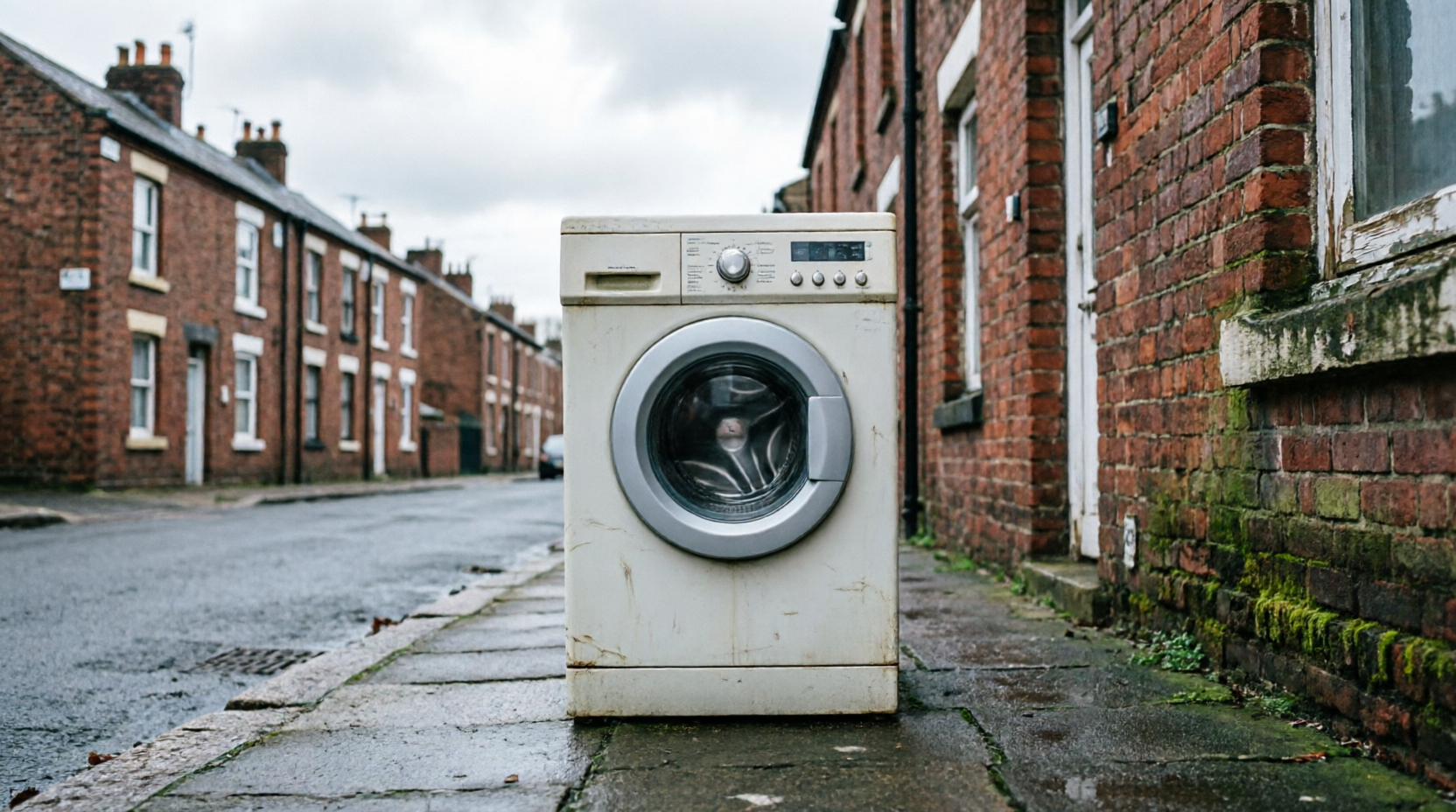
How to Get Rid of a Washing Machine in Liverpool & Merseyside (Every Option Explained)
Your old washing machine weighs 60–80kg, won't fit in your bin, and is classified as electrical waste. Here's every legal way to dispose of one — ranked by cost, speed, and how much heavy lifting you'll have to do.
Washing machines are one of the most awkward appliances to get rid of. They're heavy, bulky, full of residual water, and classified as WEEE (Waste Electrical and Electronic Equipment) — which means they can't go in a skip or a wheelie bin. They need to be processed at an authorised treatment facility where metals, plastics, and other materials are separated and recycled.
The good news: unlike a fridge or freezer, washing machines don't contain refrigerant gases, so disposal is simpler and usually cheaper. Around 85–90% of the materials in a typical washing machine can be recovered and recycled — mainly steel, which makes up the drum and outer casing.
Your Options at a Glance
| Option | Cost | Speed | Effort |
|---|---|---|---|
| Retailer take-back | Free – £20 | On delivery day | Zero — they swap it |
| Council bulky collection | Free (Liverpool) / £25–£31 rest of Merseyside | 1–3 weeks | You move it outside |
| Recycling centre (HWRC) | Free | Same day | You transport it yourself |
| Private clearance company | ~£35–£70 | Same day / next day | They do everything |
| Scrap metal dealer | Free (sometimes) | Varies | You move it outside |
Option 1: Retailer Take-Back (Best If You're Buying New)
If you're buying a new washing machine, this is the easiest route by far. Under WEEE regulations, retailers selling large electrical appliances are legally required to offer a take-back service — one old appliance removed for every new one delivered.
How it works
- Select the old appliance removal option when placing your order — most retailers won't offer it at the door
- The delivery team disconnects and removes your old washing machine when they bring the new one
- Cost ranges from free to around £20 depending on the retailer
Major retailers including Currys, AO, John Lewis, and Argos all offer this service. Some require the old machine to be disconnected from water and drainage before the team arrives — check the terms when ordering.
Best for: Anyone buying a replacement washing machine. Zero effort, legally compliant, and the cheapest option. Always check this first — it solves the problem completely.
Option 2: Council Bulky Item Collection
Liverpool City Council includes washing machines in its free bulky item collection service. The appliance counts as one of your 5 bulky items per collection, alongside up to 5 small electrical items.
Requirements
- The washing machine must be disconnected from water, drainage, and electricity
- It must be placed at the front of your property before 7:30am on collection day
- The council team will not enter your home, disconnect the machine, or help you move it
A standard washing machine weighs 60–80kg. Moving one from a kitchen, through a hallway, possibly over a door step and out to the kerb is a serious physical task — especially if you live alone or have mobility issues. The drum retains water even after the final spin cycle, adding extra weight and creating a sloshing, unbalanced load that's difficult to control.
Live outside Liverpool city? Sefton, Wirral, Knowsley, and St Helens charge £25–£31 for bulky collection — still kerbside only. At that price, a private company collecting from your kitchen for £35–£70 becomes very competitive. See our council vs private comparison for the full breakdown.
Option 3: Take It to a Recycling Centre
Liverpool's Otterspool and Old Swan Household Waste Recycling Centres accept washing machines for free in their dedicated WEEE containers.
The problem is logistics. A washing machine won't fit in a car boot, and even getting it into a van requires at least two people and ideally a trolley or sack truck. It's the fastest free option if you have the right vehicle and help — but for most people it's impractical.
Drain it first. Before transporting a washing machine, tilt it back slightly to drain residual water from the drum and hoses. A machine that hasn't been drained properly can leak 5–10 litres of dirty water in your vehicle.
Option 4: Hire a Licensed Clearance Company
A clearance company will disconnect the washing machine (if needed), carry it from your kitchen, load it into their van, and take it to a licensed facility for WEEE processing. No heavy lifting, no transport headaches, no waiting weeks.
What to expect
- Cost: Typically £35–£70 for a single washing machine. Often cheaper than a fridge or freezer because there's no refrigerant gas to deal with.
- Speed: Same-day or next-day collection across Liverpool and Merseyside
- Effort: None — they handle disconnection, carrying, and loading
- Bundling discount: If you're getting rid of other items at the same time (a sofa, old mattress, or general household waste), combining them into one collection is significantly cheaper than separate bookings
Best for: Anyone who can't physically move a 70kg washing machine, lives in a flat or house with difficult access, or needs it gone quickly. The cost is modest — and dramatically cheaper than a skip for a single appliance.
Always check the licence. Washing machines are classified as WEEE — they must end up at an authorised treatment facility. If an unlicensed collector dumps your old machine, you can be held responsible under the Duty of Care regulations. Always verify the Waste Carrier Licence on the Environment Agency register. Don't fall for the "cheap man with a van" offering to take it for £10.
Need a washing machine collected? Compare prices first.
Post your job on JunkBid and get free quotes from licensed clearance companies across Liverpool & Merseyside.
Get Free QuotesFree service • Takes under 2 minutes • Verified Waste Carriers only
Option 5: Scrap Metal Dealers
Washing machines have more scrap value than most appliances — the steel drum and casing can be worth £5–£12 at current scrap metal prices. Some scrap dealers will collect for free based on this value, though it fluctuates with the metal market.
What to check
- The dealer must hold both a Scrap Metal Dealer's licence (under the Scrap Metal Dealers Act 2013) and a Waste Carrier Licence
- They should take the machine to a WEEE-authorised facility, not just strip the metal and dump the shell
- Ask for a Waste Transfer Note as proof of proper disposal
- Under UK law, paying cash on collection for scrap metal is illegal — legitimate dealers pay by bank transfer with identity verification
Be careful with doorstep scrap collectors. Unlicensed collectors driving through residential streets often strip high-value components (copper wiring, motors) and fly-tip the remaining shell. If they dump your machine, you remain legally liable as the original owner. Only use this route if you can verify the dealer's licence and get a Waste Transfer Note.
Sell It or Give It Away (If It Still Works)
If your washing machine is still in good working order and less than 5–7 years old, selling it is worth trying before paying for disposal. A working machine can sell for £50–£150 on Facebook Marketplace or Gumtree — more than enough to offset the cost of a new one. List it as "collection only" so the buyer handles transport.
Alternatively, local Freecycle or Freegle groups in Liverpool can connect you with someone who needs a working machine and will collect it for free.
If it hasn't sold within a week, move on to another option rather than letting it sit.
What About Donating a Working Washing Machine?
If your washing machine is still in good working order — genuinely functional, not "it worked last time I used it three months ago" — donation is worth exploring. Some charities accept working appliances, but the bar is high:
- The machine must be in full working order with no leaks, error codes, or faults
- It must be reasonably modern — charities typically decline machines over 8–10 years old
- It needs to be clean, with no mould, odour, or limescale buildup
- The charity will need to PAT test it before redistribution
Call ahead before assuming any charity will accept it. Many have stopped taking large appliances due to the cost of testing, transport, and the risk of liability.
What You Cannot Do
- Put it in a skip. Washing machines are WEEE — most skip companies will refuse them. See our skip hire guide for what skips can and can't take.
- Leave it on the street. Unless it's an confirmed council collection day, this is fly-tipping — a criminal offence with fines up to £50,000.
- Put it in your wheelie bin. It won't fit, and even if it did, WEEE items must go through specialist processing.
- Give it to an unlicensed collector. If they dump it, you're legally responsible.
Quick Decision Guide
- Are you buying a new washing machine? → Use retailer take-back. Easiest option, often free.
- Is it still working and less than 5–7 years old? → Try selling on Facebook Marketplace or Gumtree (£50–£150), or donate to a local charity (call first).
- Can you physically move 60–80kg to the kerb and wait 1–3 weeks? → Book your local council collection (free in Liverpool, £25–£31 elsewhere in Merseyside).
- Have a van, a trolley, and a helper? → Drive it to Otterspool or Old Swan recycling centre.
- Need it gone fast, can't move it, or none of the above work? → Get free quotes from licensed companies on JunkBid — most collections happen within 24–48 hours.
Most common scenario: A washing machine that's broken down, sitting in the kitchen blocking the space where the new one needs to go. You can't lift it yourself, the delivery team won't take the old one unless you pre-booked removal, and you need it gone before the plumber arrives to install the replacement. A licensed clearance company collecting from your kitchen for £35–£70 is the practical answer.
Frequently Asked Questions
How much does it cost to get rid of a washing machine in Liverpool?
Free via Liverpool City Council's bulky collection (kerbside only), or free at Otterspool and Old Swan recycling centres. Retailer take-back costs free to £20 when buying new. Private clearance companies charge £35–£70 for in-home collection. Scrap metal dealers may collect for free depending on market conditions. See our full pricing guide for more detail.
Can I put a washing machine in a skip?
No. Washing machines are classified as WEEE (Waste Electrical and Electronic Equipment) and must be processed at an authorised treatment facility. Most skip companies will refuse them.
Will the council collect a washing machine from inside my house?
No. Liverpool's bulky collection is kerbside only — you must disconnect the machine and move it to the front of your property yourself. If you can't do this, a private clearance company will collect from your kitchen or utility room.
Do I need to disconnect the washing machine before collection?
Yes — for all disposal options except private clearance (where the team typically handles disconnection). Turn off the water supply, disconnect the fill and drain hoses, unplug from the mains, and allow any residual water to drain. Tilt the machine back slightly to empty the drum completely.
What happens to a washing machine after it's collected?
At a licensed WEEE treatment facility, the machine is dismantled and separated into its component materials. Steel (drum, casing) is sent for scrap recycling, concrete counterweights are crushed for aggregate, and plastics, rubber, and wiring are processed separately. Around 85–90% of the materials are recovered and recycled.
Is a washing machine worth anything as scrap?
Yes — the steel content gives a typical washing machine a scrap value of roughly £5–£12 at current prices. Some scrap dealers will collect for free based on this value, though it fluctuates with the metal market.
Need a Washing Machine Collected?
Post your job on JunkBid and compare free quotes from licensed clearance companies across Liverpool & Merseyside. Most collections happen within 24–48 hours.
Get Your Free Quotes →Free service • Takes under 2 minutes • Verified Waste Carriers only