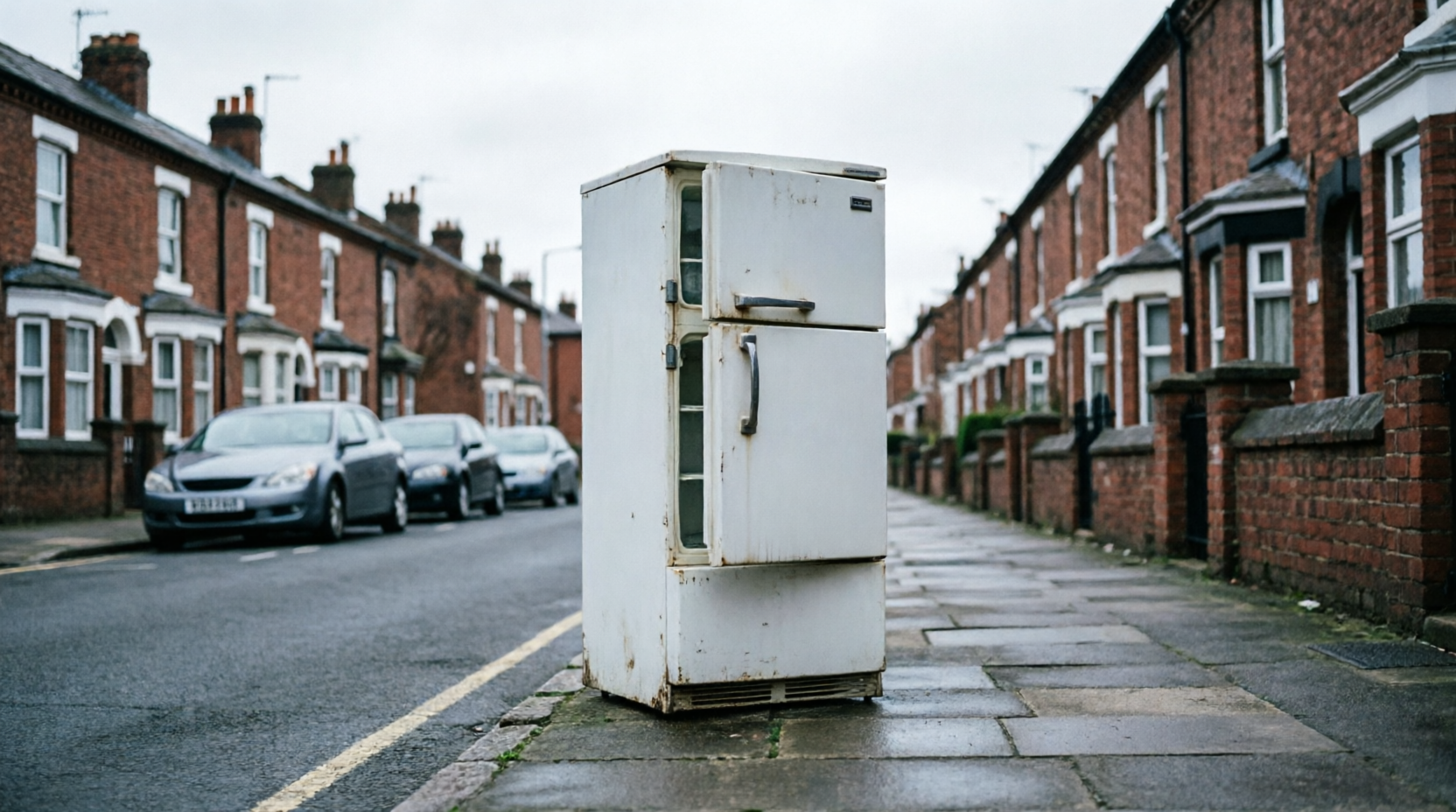
How to Get Rid of a Fridge or Freezer in Liverpool & Merseyside (Every Legal Option)
Fridges and freezers can't go in a skip, can't go in your bin, and can't be left on the street. They contain refrigerant gases that require specialist handling. Here's every legal way to dispose of one in Liverpool.
Getting rid of an old fridge or freezer is more complicated than most people expect. Unlike a sofa or mattress, a fridge contains refrigerant gases and insulating foams that are harmful to the environment if released. Under UK WEEE (Waste Electrical and Electronic Equipment) regulations, these appliances must be processed at authorised treatment facilities — not dumped in general waste.
The good news: you have several legitimate options in Liverpool and Merseyside. The right one depends on whether you're buying a replacement, how quickly you need it gone, and whether you can move it yourself.
Your Options at a Glance
| Option | Cost | Speed | Effort |
|---|---|---|---|
| Retailer take-back | Free – £20 | On delivery day | Zero — they swap it |
| Council bulky collection | Free (Liverpool) / £25–£31 rest of Merseyside | 1–3 weeks | You move it outside |
| Recycling centre (HWRC) | Free | Same day | You transport it yourself |
| Private clearance company | ~£40–£80 | Same day / next day | They do everything |
| Scrap metal dealer | Free (sometimes) | Varies | You move it outside |
Why Fridges and Freezers Need Special Handling
Before looking at each option, it's worth understanding why you can't just throw a fridge away like any other bulky item.
Fridges and freezers contain refrigerant gases (historically CFCs and HCFCs, now more commonly HFCs) sealed in their cooling systems. These gases are potent greenhouse gases — some are thousands of times more damaging than CO2 if released into the atmosphere. The insulating foam in older models can also contain ozone-depleting substances.
Under WEEE regulations, these appliances must be taken to an authorised treatment facility where the gases are safely extracted (degassed) before the metals, plastics, and other materials are recycled. This process requires specialist equipment — it's not something a general waste carrier can do.
This is not optional. Dumping a fridge — whether in a skip, an alley, or via an unlicensed collector — is illegal. Under the Environmental Protection Act 1990, you can face fines up to £5,000 in a magistrates' court for failing in your Duty of Care. The appliance must reach a licensed WEEE treatment facility. Always verify that whoever collects your fridge is properly authorised.
Option 1: Retailer Take-Back (Easiest If You're Buying New)
If you're buying a new fridge or freezer, this is by far the simplest route. Under WEEE regulations, retailers who sell large electrical appliances are legally obliged to offer to collect your old one on a like-for-like basis — one new appliance in, one old appliance out.
How it works
- Select the old appliance removal option when placing your order (not on delivery day — most retailers won't offer it at the door)
- The delivery team disconnects and removes your old fridge when they bring the new one
- Cost ranges from free to around £20 depending on the retailer
Major retailers including Currys, AO, John Lewis, and Argos all offer this service. Check the specific terms when ordering — some require the old appliance to be disconnected and defrosted beforehand.
Best for: Anyone replacing their fridge or freezer. Zero effort, legally compliant, and the cheapest option available. If you're buying new, always check this first — it eliminates the problem entirely.
Option 2: Council Bulky Item Collection
Liverpool City Council includes fridges and freezers in its free bulky item collection service. The appliance counts as one of your 5 bulky items per collection, alongside up to 5 small electrical items.
Requirements
- The fridge or freezer must be cleaned out and defrosted before collection
- It must be placed at the front of your property before 7:30am on collection day
- The council team will not enter your home or disconnect the appliance
This is free and legitimate — but you need to get a heavy appliance from your kitchen to the kerbside yourself. A standard fridge-freezer weighs 60–80kg. Moving one through a narrow terraced house hallway, down steps, and out the front door is a serious physical task — and risky without proper equipment.
Live outside Liverpool city? If you're in Sefton, Wirral, Knowsley, or St Helens, your council's bulky collection typically costs £25–£31 — and is still kerbside only. At that price, a private company collecting from your kitchen for £40–£80 is a much closer comparison.
Option 3: Take It to a Recycling Centre
Liverpool's Otterspool and Old Swan Household Waste Recycling Centres both accept fridges and freezers for free. They have dedicated containers for cooling appliances, separate from general waste, ensuring proper WEEE processing.
The challenge is transport. A fridge-freezer won't fit in most cars — you'll need a van or trailer, plus at least one other person to help load and unload. Van users are limited to 12 visits per year and may need proof of Liverpool residency.
If you have access to a van and a willing helper, this is the fastest free option — same-day disposal, no booking required for cars. But for most people, the logistics make it impractical.
Option 4: Hire a Licensed Clearance Company
A clearance company will disconnect the fridge (if needed), carry it out from wherever it sits in your home — kitchen, utility room, garage, upstairs — load it into their van, and take it to a licensed WEEE facility for degassing and recycling.
What to expect
- Cost: Typically £40–£80 for a single fridge or freezer, depending on size, access, and location. American-style double-door units may cost more due to size and weight.
- Speed: Many companies offer same-day or next-day collection
- Effort: None — they handle disconnection, carrying, and loading
Best for: Anyone who can't physically move a heavy appliance to the kerb, lives in an upper-floor flat, has a tight hallway or steps, or needs it gone quickly. The cost is modest for the convenience — and avoids the injury risk of wrestling 70kg of metal down stairs.
Critical check: Not every waste carrier is authorised to handle WEEE appliances. When getting quotes, ask specifically whether the company takes fridges to a licensed WEEE treatment facility for degassing. A general Waste Carrier Licence covers transport, but the destination facility must be WEEE-authorised. If they can't tell you where the fridge will end up, find someone who can. Check any company on the Environment Agency register.
Need a fridge or freezer collected? Compare prices first.
Post your job on JunkBid and get free quotes from licensed clearance companies across Liverpool & Merseyside.
Get Free QuotesFree service • Takes under 2 minutes • Verified Waste Carriers only
Option 5: Scrap Metal Dealers
Some scrap metal dealers will collect a fridge or freezer for free — the metal content (steel, copper, aluminium) has scrap value. However, this only works if:
- The dealer is a registered waste carrier
- They take the appliance to a WEEE-authorised facility for degassing before scrapping
- You get confirmation (ideally a Waste Transfer Note) that it's been processed properly
Be cautious here. Not all scrap collectors handle fridges properly. If someone strips the metal and dumps the rest — or worse, releases the refrigerant gas — you could be liable as the original owner. Only use this route if you can verify the dealer's credentials and disposal process.
What About Donating a Working Fridge?
If your fridge or freezer is still in good working order and you're simply upgrading, donation is worth considering. Some charities accept working appliances — but the requirements are strict:
- The appliance must be in full working order — not just "it was working when we unplugged it"
- It should be clean, with no damage, rust, or broken shelves
- Very old or inefficient models (energy rating below A+) may be declined
- The charity needs to be able to PAT test it before redistribution
Call ahead before assuming a charity will take it. Many have stopped accepting large appliances due to the cost of testing and the liability involved.
What You Absolutely Cannot Do
- Put it in a skip. Most skip companies will refuse a fridge — it's classified as WEEE, not general waste.
- Leave it on the street (unless on a confirmed council collection day). This is fly-tipping.
- Give it to an unlicensed collector. If they dump it or release the refrigerant, you're liable.
- Put it in your wheelie bin. Obviously — but worth stating.
- Remove the refrigerant yourself. This is illegal and extremely dangerous. Refrigerant extraction must be done by trained technicians at a licensed facility.
Quick Decision Guide
- Are you buying a new fridge or freezer? → Use retailer take-back. Easiest option by far.
- Is it still working and in good condition? → Try donating to a local charity (call first).
- Can you physically move it outside and wait 1–3 weeks? → Book your local council collection (free in Liverpool, £25–£31 elsewhere in Merseyside).
- Have a van and a helper? → Drive it to Otterspool or Old Swan recycling centre.
- Need it gone fast, can't move it, or none of the above work? → Get free quotes from licensed companies on JunkBid — most collections happen within 24–48 hours.
Most common scenario: A fridge-freezer that's died, sitting in the kitchen blocking space for the new one arriving next week. The old one weighs 70kg and the front door is through a narrow hallway. In that case, a licensed clearance company collecting from your kitchen for £40–£80 is the practical answer.
Frequently Asked Questions
Can I put a fridge in a skip?
No. Fridges and freezers are classified as WEEE and contain refrigerant gases that must be extracted at a specialist facility. Most skip companies will refuse to accept them. See our skip hire guide for more on what skips can and can't take.
How much does it cost to get rid of a fridge in Liverpool?
Free via Liverpool City Council's bulky collection (kerbside only), or free at Otterspool and Old Swan recycling centres. Retailer take-back costs free to £20 when buying new. Private clearance companies charge £40–£80 for in-home collection.
Will Liverpool council collect a fridge from inside my house?
No. The council's bulky collection service is kerbside only — you must move the fridge to the front of your property yourself. If you can't do this, a private clearance company will collect from your kitchen or any room.
Do I need to defrost my fridge before collection?
Yes — Liverpool City Council requires fridges and freezers to be cleaned out and defrosted before collection. Most private clearance companies can handle a fridge that hasn't been fully defrosted, but it's good practice to empty and unplug it 24 hours before collection.
Why can't fridges go in normal waste?
Fridges contain refrigerant gases (HFCs, and in older models CFCs/HCFCs) that are potent greenhouse gases — some thousands of times more harmful than CO2. Under WEEE regulations, these gases must be safely extracted at a licensed treatment facility before the appliance can be recycled. Releasing them into the atmosphere is illegal.
Can I donate a working fridge to charity?
Potentially, but standards are strict. The appliance must be in full working order, clean, undamaged, and recent enough to meet current energy efficiency standards. Many charities have stopped accepting large appliances. Always call ahead — don't turn up with a fridge unannounced.
Need a Fridge or Freezer Collected?
Post your job on JunkBid and compare free quotes from licensed clearance companies across Liverpool & Merseyside. All providers verified with a Waste Carrier Licence.
Get Your Free Quotes →Free service • Takes under 2 minutes • Verified Waste Carriers only